skip to main |
skip to sidebar
A few days ago, Jennifer J. Bennett announced her latest writing contest – a curious challenge to write a monologue of an object in your home. Of course, you can’t indicate what the object is, you can’t go beyond 1000 words, and you must provide a photo of the object. The contest ends on October 1st – at which point the voting begins (ending on October 4th)! The winner receives a Barnes & Noble gift card, courtesy of the generous Ms. Jen.
The last time that Jen ran a contest, I was unable to participate, so this time, I jumped at the chance. The name of my story is “Always a Nook or Cranny” – and per the contest instructions, I’m sharing it with you today. Also, per Jen’s instructions, I’m refraining from posting the photo of my object – which is hard for me, as I have yet to post words without at least one photo – if not more. But there’s a first time for everything!
----------
For a long time, I sat in a store, waiting. Admittedly, it was a spacious store, with tall ceilings and plenty of other waiting objects, but it was hard nonetheless, sitting amid others like me – alike in material, if not in color – waiting for someone to take me home.
Then, one afternoon, about nine months ago, an eager couple came into the store, made a beeline for my section, and picked me out from all the rest.
The woman seemed particularly excited. I even overheard her say, “I’d like to see the mess she makes now!”
The man, however, wanted a variation on my design – something even bigger and more contained. But, since the woman would be tending to me on a daily basis, her vote overruled his.
“That one’s way too big,” she said. “How can we travel with it? And it’s way too expensive. This one will do just fine... for now.”
The others of my kind glared at me. Why him, they were probably thinking. Why not me?
If I could’ve shrugged in reply, I would have. Deep down, I knew that I was special – that I could please the nice woman if only I tried hard enough – but I didn’t want the others to feel bad for not having been chosen.
As the man carted me to a checkout counter at the front of the store, I took one last look around. Since I’d first entered the place through the back door – after being plucked from a delivery truck – I’d never seen this part of the store before. Filled with shelf after shelf of assorted containers, scrumptious treats, and animated oddities, it was truly a wonder to behold – if only for a few minutes.
After the man paid for me and a few other items, he carried me to a minivan, tucked me inside, and started the engine. Once the woman had positioned her seatbelt, we were soon whisking down the highway and meandering through the narrow streets of the French Quarter – apparently in search of a parking space, which I soon realized was not easy to find.
Not long afterward, the woman lugged my lightweight but awkward frame along several blocks, through two outer doors, and up three flights of stairs. It was then that I had my first glimpse of the couple’s temporary apartment, the tall windows of which overlooked bustling Decatur Street. I also had my first glimpse at the third family member, a rowdy kitten named Ruby Azazel, who did not seem pleased to have been left behind, locked in the bathroom to muffle her cries from the neighbors.
Soon, the nice woman had arranged me inside and out, tucked me in a corner of the small room, and left me to do the only job that I know how to do – more sitting, more waiting – but at least I felt welcome in this new place. Every day, the woman made sure that I was neat and tidy, free of unnecessary debris.
“So, how are things going?” the man asked her one afternoon.
“Terrific,” she said. “The messes are much smaller now. Think we’ve solved the problem.”
“No more screaming and threatening to take her back?”
She blushed. “No. No more screaming... for now.”
Of course, messes still happened. The woman had to use the broom or mini-vacuum every day. Sometimes, plastic bags and deodorizer were required, and once a month, I underwent routine maintenance. But, on the whole, she seemed to be happy with me – so much so that I was invited to travel with the man, the woman, and the kitty to their next destination: an extended-stay hotel room in Los Angeles, where I was promptly tucked beneath a sink.
From my shadowy nook, I witnessed a lot of frenzied activity over the next two months. The ever-curious kitty sliced her paw on a misplaced razor, upsetting the woman greatly. The man made a lot of aromatic meals in the small kitchenette, while the woman tried her best to keep up with the dishes.
Once, a horribly high-pitched fire alarm went off – due, as I later discovered, to someone else’s culinary mishap – and the couple rushed outside to await the fire brigade. Even after the threat was neutralized, the alarm wouldn’t stop blaring, and the woman returned for the kitty, who had apparently flipped over her carrier and crawled beneath the blanket inside, to evade the screeching sounds. This time, the woman took the kitty with her, worried that the alarm might have damaged Ruby’s tiny ears. It saddened me that she didn’t think to take me, too.
Occasionally, the man and woman donned nice clothes, fixed their hair, and headed out to see some old friends – folks with whom they used to socialize more often, back when they were living in Los Angeles year-round. I gathered that they didn’t like the city very much – not that I ever saw anything more than my corner. Supposedly, they were only in town for a film festival that they’d run for several years. I guess that explained the bins of supplies and videotapes that frequently passed through the door, especially toward the end of their stay.
In their next home, a high-ceilinged studio above Bourbon Street, I dwelled beneath the stairs that led to the sleeping loft and kept my eye on the kitty, whose paws were sore from having been declawed. Here, in northern Michigan, I’ve sat in a corner, between a storage closet and the bathroom, for the past five months, and soon I’ll be returning to New Orleans, where my life with this small nomadic pack began.
Even though I’m always relegated to an out-of-the-way nook or cranny, I’m rarely ignored for long. My adopted family seems to approve of me – even little Ruby, who incidentally isn’t so little anymore – and I do my job admirably. Moving around the country so often isn’t so bad either – at least the scenery changes – from what I can see of it.
----------
Can you guess what the object is? I didn’t make it too difficult, I must admit.
But, even if it is easy to guess, I loved writing it. It’s fun – and enlightening – to write from a completely different point of view. I do something similar at the Come In Character site, where authors converge to interact with one another’s characters. Writing from the perspective of an object, however, was a whole new experience. Maybe I should do it more often. As Pixar films have done for toys, bugs, monsters, fish, cars, and rodents, this kind of writing might just let me see household objects in a whole new light. Thanks, Jen!
 For my American Nomad blog, I recently posted an article about train travel. Although Dan and I frequently travel by car, we’ve certainly been known to board a train or two over the years. Before I even met Dan, I had ridden my fair share of trains, even taking Amtrak’s City of New Orleans from the Big Easy (my hometown) to Chicago (where I was attending college at the time). And right after meeting Dan (but before we were an “item”), I took a trip to Italy, where I experienced a six-hour train ride from Venice to Rome – what an amazing journey that was!
 When Dan and I lived in England, we often used trains to get from Henley-on-Thames, where we were living, to towns like Reading and London. It really was a more efficient and less harrowing way to travel than driving on Britain’s poorly marked roadways. And, of course, while residing in places like Chicago and Los Angeles, we used the public trains a lot – especially in the Windy City, which has a truly incredible system. Chicago’s trains almost always got us to our destination on time – whether it was an office building in the Loop or the Midway airport – and it was so much cheaper and faster than driving in the Chicagoland area.
 Although I never collected trains as a child, I’ve always been fascinated with them. Despite the decline in U.S. train travel over the past century, America’s history will forever be intertwined with locomotives – and there’s nothing quite like riding the rails. If you don’t have time for a lengthy Amtrak journey, there are plenty of smaller lines throughout the country, offering short, nostalgic train rides for visitors. And, in lieu of that, you can always take the silly tourist train rides on offer in certain resort towns, such as Key West’s Conch Tour Train. Hey, don’t laugh – it’s fun!
 While doing my research for the travel article, I discovered this interesting partnership between Amtrak and the National Park Service. Called Trails & Rails, the program “provides rail passengers with educational opportunities that foster an appreciation of a selected region’s natural and cultural heritage... promotes National Park Service areas...” and attempts “to encourage train ridership” – which I think is pretty awesome. Apparently, Amtrak and the National Park Service are also helping to celebrate the next National Train Day (yes, we have one of those), which is scheduled for next May. I’m personally heartened by all this attention to train travel, which is slowly becoming a thing of the past.
So, do any of you have fond memories of past train rides? Or is it time to take your first trip?
 Back in July, I wrote about the little garden that Dan and I typically grow every summer in northern Michigan – or perhaps I should say “attempt to grow every summer” because the unusually cool weather has not been kind to our veggies this season. Many of our herbs shriveled early, and the cucumbers were less than promising. As usual, our zucchini thrived – a few even grew to record size – and the cherry tomatoes, though late, have been consistently delicious for the past few weeks. But the big surprise this summer has been one of the plants that I’ve been tending. Every season, I try something new – and this year, it was – you guessed it – eggplant!
 Early in the summer, Dan had had his doubts. The wee card embedded in the potted eggplant that we’d bought at the hardware store promised that this particular bush could produce up to fifty eggplant in one season. Dan scoffed at such a number, but the prospect intrigued me – and served as a challenge to my nonexistent gardening skills. In Dan’s defense, neither of us had attempted to grow eggplant before. But, since I’ve been on an eggplant kick lately – perhaps recalling the delicious eggplant parmesan I’d had at Mona Lisa, a quaint Italian restaurant in the French Quarter – I was determined to watch it grow... and grow it did. In June and July, it did little more than stay alive, but by August, the lavender-hued blossoms were beginning to transform into purplish-black pods – like something out of a “body snatcher” flick.
 I was so bloody excited the day that I noticed my first eggplant “pod” – and soon, there were seven little pods of various sizes. One, in particular, looked pretty darn healthy. It grew at the base of the stalk, eventually growing too long to hang. For a long time, it lay atop the potting soil, getting longer and bigger every day. Concerned about rot, I checked it regularly, but I was emphatically told by my mother (via a long-distance phone call) not to pluck it until it was tender. I felt it daily for signs of a change in texture, but it just continued to grow. Eventually, I broke down and bought a full-sized eggplant from the grocery store (pictured here beside my little homegrown one). I know it seems like a betrayal, but I was dying for a nice plate of grilled eggplant. If you must know, Karma got its revenge – I ended up burning the store-bought eggplant on the grill. Sigh.
 As Inigo Montoya says in The Princess Bride, “I hate waiting.” And yet, that’s exactly what I did. I waited and I waited and I waited some more, and finally my low-hanging eggplant seemed ready to pluck. It was on the small side – compared to those found in most produce sections – but it definitely felt right when I squeezed it – and another one of the seven was close on its heels, almost ready to be plucked as well. Visions of eggplant parmesan began dancing across my inner sanctum. I had promised Dan for weeks that I was going to prepare eggplant parmesan, but as usual, I procrastinated and Dan eventually decided to make it without my assistance – which, while I felt bad about breaking another cooking-related promise (for, yes, this was hardly the first time), was ultimately a good thing.
 After all, Dan is the chef in the family – and he’d actually been proactive enough to find a recipe that included red, orange, and yellow peppers (the very peppers that were waiting patiently in the refrigerator to be eaten).
“What?” I said. “Peppers in eggplant parmesan? Who would do such a dastardly thing?”
Apparently, Giada De Laurentiis, the Food Network’s lovely Italian vixen, would. It was her recipe he’d found, and then, being Dan, promptly manipulated. And even though I’d never before spotted a single pepper piece in a dish of traditional eggplant parmesan, I was more than willing to give it a try. For one thing, Dan was eager to cook in my stead. For another thing, I trusted his judgment – and I pretty much like everything that Giada makes.
So, though I offered to help him slice the peppers and eggplant, he shooed me into the bathroom to take a shower. We were, after all, having dinner with his parents, and it’s usually polite to be clean for the occasion.
“But, Dan, will two eggplant be enough for all for of us?”
He sighed. “Yes, more than enough. I’m making sausage, too, you know.”
 Naturally. The Martones are Italian, after all; there’s almost always meat at a family dinner. In fact, I think I might have been the only one to have ever eaten eggplant parmesan as an entrée.
Without another peep, I dutifully shuffled into the bathroom. By the time I’d emerged, Dan had already sliced and grilled the eggplant. Then, I watched him as he lay the thick eggplant slices on a layer of tomato sauce, followed by a handful of shredded mozzarella and parmesan, more sauce, and rows of vibrant pepper slices, above which he added more cheese, more sauce, and, of course, more cheese. Didn’t I mention we’re Italian? (Well, for the most part anyway.)
 I have to admit that, after all my skepticism, Dan’s eggplant parmesan turned out pretty good. It was delicious, in fact – and, as with most dishes he prepares, the best I’ve ever had. He was right, too, about the amount. With the stewed sausage, there was plenty of eggplant parmesan to go around. In fact, there were enough leftovers that I was able to have three more meals’ worth over the course of the week. I’m more than happy to admit that he was right about the recipe – if only Dan were willing to admit that he was wrong about my poor little bush. It might not have produced fifty eggplant as promised, but it gave us seven more than he expected, and that’s reason enough to be happy with “the little garden that could.”
As many of you know, I’m about to embark on what I hope will be the final revision for my first novel, Hollow Souls. Given the momentous task ahead of me, I’ve naturally procrastinated all summer, and yet I’m still thrilled by the world I've created, and excited to see the novel in its finished (and hopefully much shorter) form.
 So, it might come as a surprise to learn that I’ve already begun drafting my second novel, a coming-of-age, cross-country drama entitled Red Road Crossing, which, as the title implies, has a Native American theme. While my first novel is told in third person, from the perspectives of a mother and daughter, Devi Marconi and Olivia Harper, my second novel will be told in first person, through the eyes, ears, hearts, and minds of five characters: Meg, a seventeen-year-old girl in search of her long-lost mother; Meg's half-brother, Jonathan; Meg’s stepmother, Billie; Meg’s first lover, Indigo; and Meg’s father, Thomas, owner and operator of a vision quest camp for troubled teenagers.
 Since I plan to explore such varied voices in my second novel – in a similar vein to William Faulkner’s As I Lay Dying – I’ve begun to practice writing the voices with which I’m unfamiliar, such as ten-year-old Jonathan. A while ago, I tested my abilities by writing a short story from a young boy’s point of view. Called “351” – and posted on my Ruby Hollow website – the story draws its inspiration from my own childhood fishing trips with my father. I’ve decided to post it here today – just to see what you think about it. Have I accurately captured the thoughts of this boy, or is he too smart for his own good? I’m looking for honest opinions, so please don’t hold back.
----------
My dad's boat is older than me. I know every dent. Every leak. I know how the cushion feels on the green aluminum seat under my shorts. I know the metal side is cold in the morning and burns my hand by noon. Even when I'm back home, I can hear the sputtering motor in my head.
There's a slight breeze as we skim across the water. We're going fast, trying to make the most of the day, so the ride's a bit bumpier than usual. I'm glad for the cushion.
The sun's coming up, and the water's still. Dad's behind me, steering the boat.
“Smooth as glass,” he says. “Fog's burning off. Shaping up to be a nice day.”
I can feel his eyes on my neck.
“You okay, Charlie?”
I listen to the motor and the splashes below. “Wish I could stay longer.”
 The marsh comes into view. “I know. Two weeks is never enough.”
What he doesn't say is what I'm feeling. I wish I could live with Dad all year long. He has a small house on stilts, in the middle of a marsh near the gulf. Bought it after the divorce. He uses the beat-up boat to run errands and ride to and from his bait shop on the shore. He's got a few fishing buddies around. He may have a car somewhere, but I'm not sure.
I look forward to our summer visit. We get up early every morning, when the sky's still a purplish blue, before dawn breaks. We head out, whether the radio says rain or shine, to fish for trout or redfish. The redfish are fun to catch – tough to find and even harder to reel in.
We return to his tiny dock by late afternoon, and I usually swim – though when the tide brings the jellyfish in, it's time to get out. We spend the evenings playing cards, taking boat rides, or just talking about stuff. We usually fry up the day's catch, if there is one, and eat it with our fingers. Something I could never get away with at home. When it's dark, we fish some more. The light on Dad's house attracts bugs, which lures some pretty huge fish, and we use his big nets to scoop them up onto the dock. We get to bed by ten or so, and we're up again by five.
 It's a routine, but it's ours – those two weeks a year. The rest of the time I live with my mom and stepdad in Chicago.
My folks split when I was seven, and me and Mom moved a thousand miles away. We didn't take much with us. A man up north was waiting, and he had a lot of nice stuff to share. Maybe that's why they split, I don't know.
Dad fought to keep me, but Mom wouldn't let up. I guess when he was eighteen, he held up a gas station on a dare. The gun wasn't loaded, but it didn't matter. He had a record, and Mom brought it up as much as possible, saying he wasn't fit to take care of me, and the judges always agreed with her. Dad used to say it was the stupidest thing he's ever done. But, after awhile, he stopped talking about it, and we settled for our summers.
We're deep into the marsh now. There are seagulls in the sky, screeching and searching for food. I can see other fishing boats anchored in the reeds.
Dad and I haven't had much luck this time around. We've caught a few trout here and there, but often, come suppertime, we've had to thaw out packages of frozen fish from last month's catch. Course, as Dad always says, “A bad day fishing beats a good day working.”
 He shuts the motor, pushes his pole along the bottom, and guides us through the reeds. I spot a few swirls near the water's edge, so Dad drops anchor, and we quietly bait our hooks with raw shrimp.
We fish for a long time, feeling a nibble here and there. But the swirls soon disappear, and our luck runs out again. We move to another spot, but it's the same story.
Dad takes us for a boat ride, perhaps to a better cut, but we have even less luck here. Not even a nibble. So we take a lunch break, eating our ham sandwiches in silence. I feel terrible, and Dad doesn't look much better. It's our last day together. My stepdad will be waiting on the shore in a few hours, next to his rented sports car. They don't even trust me to take a plane by myself. Or maybe it's Dad they don't trust.
After lunch, we search for a luckier spot. It's the hottest part of the day, but I'm determined to catch a big one.
A few hours pass, and still nothing. I see Dad glance at his watch.
I cast my line out toward a lonely bunch of weeds. “I wish time could stop.”
“I know what you mean, son.” He smiles.
Maybe a boy isn't supposed to say so, but I love my dad's smile.
The gnats nip at our faces and limbs. My sunburned skin itches in places. But the breeze feels nice. Suddenly, I sense a tug on my line. Often, a nibble can catch you off guard, and the fish is gone with your bait before you've even had a chance to touch the reel. But, this time, I'm ready. I pull back gently and snag him. He puts up a fierce fight, pulling out the line as fast as I can reel it in.
“Got something?” Dad keeps a firm grip on his own pole, eyeing his bobber but watching my struggle closely.
“I think it's a red.” I'm excited, but it's hard work.
“That's it, son. He's wearing out – holy shit! I've got one, too.”
 We're playing tug o' war with our lines. I pull my red in first. He's a big guy – nearly twenty-eight inches. The hook's deep inside, but I manage to yank it out, and he falls near my feet. I grab him quick, slimy as he is, and drop him in the ice chest. Dad flops his own catch next to mine. It's a few inches shorter but still beautiful.
“Looks like you beat your old dad this time.”
I'm beaming, worn out but proud. The fish are flopping about, slower now but still fighting to find a way overboard.
Dad glances at his watch again and frowns a little. “I'll have to take you back in a few minutes.”
My throat feels choked. The fish look lifeless now amid the chunks of ice. “Too bad there's no time to eat 'em.”
“Oh, these are too good to eat. I'll have 'em mounted for next time you come.” Dad shuts the ice chest. “Well, let's get going.”
We each take our places – him near the motor, me up front.
The ride's long, but not long enough. It's late afternoon and cool again. The wind blows my hair. Mom'll make me cut it first thing.
 Soon, the boat slows down, and I can see the dock, surrounded by seagulls. My stepdad is on time as usual, leaning against the hood of a slick black car.
The boat putters toward the wharf, and Dad ties a rope to a crusty post.
Mr. Chuck, the nice old man who owns the boat launch, stands nearby. “Your son's getting big, Lou. He'll be a man soon.”
“He already is.”
We climb onto the dock. My stepdad watches silently. He doesn't even wave.
Dad opens the ice chest, and Mr. Chuck spies the fish. “Nice catch.”
“Charlie got the bigger one.”
There's an awkward pause. Mr. Chuck knows I'm going back. “You know, Rita just bought me a Polaroid. Haven't tried it out yet.”
My stepdad stands up, waiting, probably wondering what's going on.
Mr. Chuck's back in a flash – well, for an old man, he is.
Dad kneels and reaches for the redfish. We hold them high, though I want to put an arm around him.
The picture soon fades into view. My eyes are shut a little, but we're both grinning.
Mr. Chuck hands it to me. “You gotta remember these moments.”
“Oh, we will.” Dad gives me a hug. “Good luck at school. Call me if you need anything.”
I fetch my backpack from the bow and head toward the car, but I want to turn back.
My stepdad opens the door. I look down at my picture. What a fish. My friend Bryan'll be jealous. As I get in, I see my dad watching me from the dock. He looks sad. I try to smile. It'll be a hard year, but next summer will come eventually.
In 351 days.
 I have a confession to make. After all my blathering in the blogosphere a couple weeks back about the thrill of driving two hours to see the 3-D spectacle The Final Destination, I must admit that I was less than thrilled – even despite very low expectations. True, it didn’t help that the couple that went with me and Dan walked out halfway through the film. After all, I tend to be overly sensitive about disappointing people – despite the fact that I didn’t make the movie, that I warned them it could be bad, and that the male half of the couple has notoriously bolted out of 20 percent of the movies he’s seen. What can I say? I’ve always been affected by other people’s moods.
 But beyond all that, it’s just a horrid movie. First off, the acting is fairly dreadful – even from the likes of Mykelti Williamson, who’s usually good in everything he does, from Forrest Gump (1994) to August Rush (2007). Secondly, the kills are pretty outrageous, even by Final Destination franchise standards. Lastly, due to poor writing (as well as poor acting), I really didn’t care about any of the characters – which means I really didn’t care if anyone lived or died. Whether you like horror movies or not, you can probably agree that the more you care about the characters involved, the higher the stakes and, therefore, the scarier the film. Scoff if you will, but that’s what I like about the first three films – true, they’re gory and outrageous, but each one also has at least one character for whom I can root – though, admittedly, the films have gotten progressively worse in regards to character development.
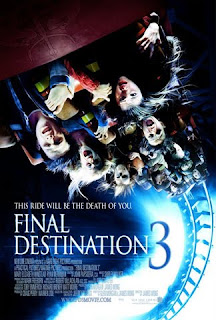 Going into this fourth film, my expectations were super-low. For one thing, while the first three films focus on tragic accidents that terrify most folks in the modern age – plane crash, highway pile-up, and roller-coaster snafu – this one begins with a rather ridiculous fiasco at a racetrack – which I’ve feared less during my lifetime than getting hit by a wayward puck at a hockey game. The other thing that concerned me was that I suspected the filmmakers would be so preoccupied with setting up elaborate death scenes that made the most of the 3-D technology that they would fail to concentrate on something more important – the screenplay – and sadly, I was right.
 So, I guess even my low expectations just weren’t low enough. And yet, despite the fact that the movie was mediocre and our friends’ sudden departure perturbed me, I’m glad that we saw it. ‘Cause the 3-D technology was indeed well done – and boy, did we laugh! It might not have been billed as a comedy, but it sure does seem like one. In its own way, it also respects the franchise audience – even having a unique opening credit sequence that uses skeletons to demonstrate kills from the previous three movies. And there are a couple scenes that genuinely freaked me out – guess I’m not the only one who finds escalators and automatic car washes terrifying.
 As a bonus, this curious experience has made me reflect on the nature of expectation: how, sometimes, high expectations can ruin a perfectly good movie (like Signs, which I hated the first time I saw it and have now grown to love) and how the opposite can also be true – that low expectations can often heighten the movie experience. That’s what happened with this summer’s Star Trek remake. Despite some serious doubt, I enjoyed the heck out of that flick – especially Karl Urban’s spot-on performance as the insufferable Bones.
So, have expectations played a role in your movie-going experiences? If so, what film overcame your lowest expectations, and which fell far short of your hopes?
 Although I’d intended to use my “Thoughtful Thursday” posts to explore the journal I kept during my first vision quest experience, I was compelled to deviate last week in order to share my yoga woes with you. What can I say? The kitty looked so darn cute under the yoga mat, I simply had to rethink my intentions.
But, this week, I’m back in full vision quest mode. In case you’re utterly confused, please check out my four previous posts about the weeklong vision quest that I experienced during the summer before ninth grade, in the woods of southern Mississippi.
My five fellow questers and I spent six days under the tutelage of a long-haired, big-hearted vegetarian named James, who lived on the expansive, wooded property with his wife and two daughters. What I remember most about James was his hearty laugh, his intense eyes, his bushy mustache, his refusal to watch television, his passion for the environment, and his fascination with Native American myths and traditions.
In previous blog posts, I covered most of what happened on Monday, June 25, and Tuesday, June 26. On Wednesday, June 27, it seems that I was in a serious writing mood. I even recapped the initial events of the quest:
 The first day was rough. When we got here, we rode to the camp in James’ flatbed. Then Margaret [James’ wife] checked our supplies, and we were on our way. We trekked with all of our heavy things through the woods, up hills, across the creek, to our campsite. After some instruction, we found our areas (now called homes) and set up our “tents” (a tarp over a rope tied between two trees). The rest of the day we just got settled. After dinner, though, Steve, Keith, and James talked to us about "warriors" and the ultimate one, Don Juan... [not the infamous lover but the man featured in Carlos Castaneda’s mind-bending books]
 The second day, we cooked our own food and washed our own clothes in our Maytag™ or Kenmore™ (really buckets to scrub our clothes with Octagon™ soap and rinse them twice). I finished mine late at night, missed eating dinner, but got to eat a few eggs instead. I’m going to have to use my pot somehow though – if I want to get the full effect of independence. We had also gone swimming in the creek for the second time. Then we were allowed to clean off (Advice: Use just a little Octagon™ soap – it goes a long way). After that, we planted our stave in the ground that has the medicine wheel colors on it. Then the Three Musketeers [Julia, Antonia, and I] carried two buckets of water uphill from the creek without a mishap. (Daryl fell in yesterday...)
At night, we went to a Council of the Great Spirit. We smoked the pipe twice and James read something about the Great Warrior Chief Seattle, and we passed a rock around (sort of like a conch) and could only speak when given this rock.
James said we’d be different now. It feels more like a family...
The rest of the day’s scribblings focused on the events of the third day, which mostly consisted of listening, learning, and meditating:
Today, he [James] talked about Little Mouse, who was busy working when he heard a roaring. He asked two other mice [about it] who said they hadn’t heard it and kept working. The mouse went back to work, but heard the roar again and went to investigate. He met a raccoon who showed him the roaring river and a green frog on a green lily pad. The frog told him to crouch and jump; the mouse did this and saw mountains and forests; he fell into the river, thinking the frog had tricked him. He was scared, but swam to the bank. The frog reassured him...
Did I mention that much of the vision quest consisted of learning myths? Of course, some made more sense than others. The above one, about Jumping Mouse, illustrates a willingness to leave innocence and security behind. But this next myth still boggles my mind a bit. Perhaps you can shed some light on it:
 James read us a story about two fawns whose mother is killed by their aunt, Bear. They know she will kill them, too, so they leave to go to their Grandpa, Lizard. They take all of their baskets except one. When Bear returns, she sees they are missing. She goes after them but hears a whistle (from the last basket) and returns home. This occurs continuously, each time with her getting angrier and angrier. Meanwhile, the fawns cross the river on Daddy-Long-Legs and go to the Lizard, explaining the situation to him. Bear finally gets to the river and Daddy-Long-Legs sticks out a leg, but then tips her over. She proceeds to the house where she is told by Lizard to climb down the smoke hole with her eyes shut and mouth open. She does this and he thrusts hot coals down her throat; she dies...
I must admit, that one leaves me a little clueless. Do you have any thoughts?
 Perhaps it’s the curse of being an only child, but ever since I was a kid, I’ve had a fascination with riddles and logic problems. In fact, I’m mad about them – mad, I tell you!
Occasionally, when free time has seemed possible, I’ve even been known to purchase mini-mystery collections and those giant puzzle books often available on the bargain racks of Borders and Barnes & Noble. Although such volumes usually teem with crossword puzzles, acrostics, and other similar word challenges – all of which I happily attempt – I’m truly tickled when I stumble across a logic problem, which is essentially a complicated riddle.
When I was really young, the riddles were fairly simple, but I have no doubt that they still helped to develop my intellect and stimulate my creativity. Here’s one that I recently remembered:
What word can be written forward, backward, or upside down, and can still be read from left to right? (Hint: You must use capital letters to figure it out, and although there’s only one accepted answer, I’ve since figured out at least two more.)
As the years passed, I began looking for harder and harder riddles, especially the philosophical ones... which is probably why I liked Gollum so much. Although he’s a selfish, pathetic, conniving creature in J. R. R. Tolkien’s masterpieces, The Hobbit and The Lord of the Rings, he won me over with his repertoire of riddles. Here’s one of the oft-quoted ones (which Bilbo figures out by accident):
 This thing all things devours:
Birds, beasts, trees, flowers;
Gnaws iron, bites steel;
Grinds hard stones to meal;
Slays king, ruins town,
And beats high mountain down.
As a teenager, I was especially intrigued by the rash of mystery riddles (usually involving a murder or suicide) that my classmates and I exchanged in the schoolyard. Here’s one that I actually figured out on my own:
A dead man is found in a locked room, hanging from the ceiling a few feet above the floor. The room is completely empty, except for a puddle of water below him. How did he die?
No doubt, you’ve heard all of these before. But, if not, do you care to venture a guess? Oh, and please feel free to share a riddle of your own – I’m always on the lookout for a challenge.
(Note: If you’re curious about other clever – and not-so-clever riddles – check out RiddleNut.com or Riddles.com.)